


Awards News
College of Engineering News
-

A Team of Three PhD Candidates Wins the Korea Semi..
“We felt a sense of responsibility to help the nation advance its semiconductor design technology” < PhD candidates at the School of Electrical Engineering Yoon-Seo Cho, Sun-Eui Park, and Ju-Eun Bang (from left) > A CMOS (complementary metal-oxide semiconductor)-based “ultra-low noise signal chip” for 6G communications designed by three PhD candidates at the KAIST School of Electrical Engineering won the Presidential Award at the 22nd Korea Semiconductor Design Contest. The winners are PhD candidates Sun-Eui Park, Yoon-Seo Cho, and Ju-Eun Bang from the Integrated Circuits and System Lab run by Professor Jaehyouk Choi. The contest, which is hosted by the Ministry of Trade, Industry and Energy and the Korea Semiconductors Industry Association, is one of the top national semiconductor design contests for college students. Park said the team felt a sense of responsibility to help advance semiconductor design technology in Korea when deciding to participate the contest. The team expressed deep gratitude to Professor Choi for guiding their research on 6G communications. “Our colleagues from other labs and seniors who already graduated helped us a great deal, so we owe them a lot,” explained Park. Cho added that their hard work finally got recognized and that acknowledgement pushes her to move forward with her research. Meanwhile, Bang said she is delighted to see that many people seem to be interested in her research topic. Research for 6G is attempting to reach 1 tera bps (Tbps), 50 times faster than 5G communications with transmission speeds of up to 20 gigabytes. In general, the wider the communication frequency band, the higher the data transmission speed. Thus, the use of frequency bands above 100 gigahertz is essential for delivering high data transmission speeds for 6G communications. However, it remains a big challenge to make a precise benchmark signal that can be used as a carrier wave in a high frequency band. Despite the advantages of CMOS’s ultra-small and low-power design, it still has limitations at high frequency bands and its operating frequency. Thus, it was difficult to achieve a frequency band above 100 gigahertz. To overcome these challenges, the three students introduced ultra-low noise signal generation technology that can support high-order modulation technologies. This technology is expected to contribute to increasing the price competitiveness and density of 6G communication chips that will be used in the future. 5G just got started in 2020 and still has long way to go for full commercialization. Nevertheless, many researchers have started preparing for 6G technology, targeting 2030 since a new cellular communication appears in every other decade. Professor Choi said, “Generating ultra-high frequency signals in bands above 100 GHz with highly accurate timing is one of the key technologies for implementing 6G communication hardware. Our research is significant for the development of the world’s first semiconductor chip that will use the CMOS process to achieve noise performance of less than 80fs in a frequency band above 100 GHz.” The team members plan to work as circuit designers in Korean semiconductor companies after graduation. “We will continue to research the development of signal generators on the topic of award-winning 6G. We would like to continue our research on high-speed circuit designs such as ultra-fast analog-to-digital converters,” Park added.
-

Professor Sung-Ju Lee’s Team Wins the Best Paper a..
< Professor Sung-Ju Lee, Professor Eun Kyoung, Choe Hyunsung Cho, Daeun Choi, Donghwi Kim, Wan Ju Kang (from left) > A research team led by Professor Sung-Ju Lee at the School of Electrical Engineering won the Best Paper Award and the Methods Recognition Award from ACM CSCW (International Conference on Computer-Supported Cooperative Work and Social Computing) 2021 for their paper “Reflect, not Regret: Understanding Regretful Smartphone Use with App Feature-Level Analysis”. Founded in 1986, CSCW has been a premier conference on HCI (Human Computer Interaction) and Social Computing. This year, 340 full papers were presented and the best paper awards are given to the top 1% papers of the submitted. Methods Recognition, which is a new award, is given “for strong examples of work that includes well developed, explained, or implemented methods, and methodological innovation.” Hyunsung Cho (KAIST alumus and currently a PhD candidate at Carnegie Mellon University), Daeun Choi (KAIST undergraduate researcher), Donghwi Kim (KAIST PhD Candidate), Wan Ju Kang (KAIST PhD Candidate), and Professor Eun Kyoung Choe (University of Maryland and KAIST alumna) collaborated on this research. The authors developed a tool that tracks and analyzes which features of a mobile app (e.g., Instagram’s following post, following story, recommended post, post upload, direct messaging, etc.) are in use based on a smartphone’s User Interface (UI) layout. Utilizing this novel method, the authors revealed which feature usage patterns result in regretful smartphone use. Professor Lee said, “Although many people enjoy the benefits of smartphones, issues have emerged from the overuse of smartphones. With this feature level analysis, users can reflect on their smartphone usage based on finer grained analysis and this could contribute to digital wellbeing.” < Research achievements diagram : Application feature level usage analysis / UI LAYOUT Analysis >
-

Aline and Blow-yancy Win the Red Dot Design Awards..
Professor Lee sought ‘sustainability’ while developing Aline to meet the growing awareness of ESG (environmental, social, and governance) investing. ESG investing relies on independent ratings that help consumers assess a company’s behavior and policies when it comes to its social impact. Aline’s personal value index with six main criteria translates values into sustainable finance. By gathering data from the initial survey and regular value updates, the index is weighted according to the user’s values. Based on the index, the investment portfolio will be adjusted, and consumption against the values will be tracked. Blow-yancy is a diving VR device for neutral buoyancy training. Blow-yancy’s VR mask helps divers feel like they are wearing an actual diving mask. Users can breathe through a regulator with a built-in breathing sensor. It allows training like actual diving without going into the water, therefore enabling safer diving. “We got an idea that about 74% of scuba divers come into contact with corals underwater at least once and that can cause an emergency situation. Divers who cannot maintain neutral buoyance will experience a tough time avoiding them,” said Professor Lee. The hardware consists of a nose covering VR mask, a regulator with a built-in breath sensor, and a controller for virtual BCD control. Blow-yancy’s five virtual missions were organized according to the diving process required by PADI, a professional diving education institute. Professor Lee’s team already received eight recognitions at the iF Design Award in April. Professor Lee said, “We will continue to develop the best UX design items that will improve our global recognition.”
-

Prof. Changho Suh Named the 2021 James L. Massey A..
< Professor Changho Suh > Professor Changho Suh from the School of Electrical Engineering was named the recipient of the 2021 James L.Massey Award. The award recognizes outstanding achievement in research and teaching by young scholars in the information theory community. The award is named in honor of James L. Massey, who was an internationally acclaimed pioneer in digital communications and revered teacher and mentor to communications engineers. Professor Suh is a recipient of numerous awards, including the 2021 James L. Massey Research & Teaching Award for Young Scholars from the IEEE Information Theory Society, the 2019 AFOSR Grant, the 2019 Google Education Grant, the 2018 IEIE/IEEE Joint Award, the 2015 IEIE Haedong Young Engineer Award, the 2013 IEEE Communications Society Stephen O. Rice Prize, the 2011 David J. Sakrison Memorial Prize (the best dissertation award in UC Berkeley EECS), the 2009 IEEE ISIT Best Student Paper Award, the 2020 LINKGENESIS Best Teacher Award (the campus-wide Grand Prize in Teaching), and the four Departmental Teaching Awards (2013, 2019, 2020, 2021). Dr. Suh is an IEEE Information Theory Society Distinguished Lecturer, the General Chair of the Inaugural IEEE East Asian School of Information Theory, and a Member of the Young Korean Academy of Science and Technology. He is also an Associate Editor of Machine Learning for the IEEE Transactions on Information Theory, the Editor for the IEEE Information Theory Newsletter, a Column Editor for IEEE BITS the Information Theory Magazine, an Area Chair of NeurIPS 2021, and on the Senior Program Committee of IJCAI 2019–2021.
-

Prof. Junil Choi Receives the Neal Shepherd Memori..
< Professor Junil Choi > Professor Junil Choi of the School of Electrical Engineering received the 2021 Neal Shepherd Memorial Award from the IEEE Vehicular Technology Society. The award recognizes the most outstanding paper relating to radio propagation published in major journals over the previous five years. Professor Cho, the recipient of the 2015 IEEE Signal Processing Society’s and the 2019 IEEE Communications Society’s Best Paper Award, was selected as the awardee for his paper titled “The Impact of Beamwidth on Temporal Channel Variation in Vehicular Channels and Its Implications” in IEEE Transaction on Vehicular Technology in 2017. In this paper, Professor Choi and his team derived the channel coherence time for a wireless channel as a function of the beamwidth, taking both Doppler effect and pointing error into consideration. The results showed that a nonzero optimal beamwidth exists that maximizes the channel coherence time. To reduce the impact of the overhead of doing realignment in every channel coherence time, the paper showed that the beams should be realigned every beam coherence time for the best performance. Professor Choi said, “It is quite an honor to receive this prestigious award following Professor Joonhyun Kang who won the IEEE VTS’s Jack Neubauer Memorial Award this year. It shows that our university’s pursuit of excellence in advanced research is being well recognized.”
-
Professor Kang’s Team Receives the IEEE Jack Newba..
< Professor Kang (far left), Professor Sung-Ah Chung at KNU, and Professor Osvaldo Simeone of KCL > Professor Joonhyuk Kang of the School of Electrical Engineering received the IEEE Vehicular Technology Society’s 2021 Jack Neubauer Memorial Award for his team’s paper published in IEEE Transactions on Vehicular Technology. The Jack Neubauer Memorial Award recognizes the best paper published in the IEEE Transactions on Vehicular Technology journal in the last five years. The team of authors, Professor Kang, Professor Sung-Ah Chung at Kyungpook National University, and Professor Osvaldo Simeone of King's College London reported their research titled Mobile Edge Computing via a UAV-Mounted Cloudlet: Optimization of Bit Allocation and Path Planning in IEEE Transactions on Vehicular Technology, Vol. 67, No. 3, pp. 2049-2063, in March 2018. Their paper shows how the trajectory of aircraft is optimized and resources are allocated when unmanned aerial vehicles perform edge computing to help mobile device calculations. This paper has currently recorded nearly 400 citations (based on Google Scholar). "We are very happy to see the results of proposing edge computing using unmanned aerial vehicles by applying optimization theory, and conducting research on trajectory and resource utilization of unmanned aerial vehicles that minimize power consumption," said Professor Kang.
-

Dr. Won-Joon Lee from the ADD Wins the Jeong Hun C..
< From left: KAIST PhD candidate Sok-Min Choi, Dr.Won-Joon Lee from ADD, Chong-Ho Park from Kongju National University High School, and Korea University > Dr. Won-Joon Lee from the Agency for Defense Development (ADD) became the 17th Jeong Hun Cho Award recipient. KAIST PhD candidate Sok-Min Choi from the Department of Aerospace Engineering, Master’s-PhD combined course student Hyong-Won Choi from Korea University, and Chong-Ho Park from Kongju National University High School were also selected. The award recognizes promising young scientists who makes significant achievements in the field of aerospace engineering in honor of Jeong Hun Cho, the former PhD candidate in the Department of Aerospace Engineering who died in a lab accident in May in 2003. Cho’s family endowed the award and scholarship to honor him. Three scholarship recipients from Cho’s alma mater, KAIST, Korea University, and Kongju National High School are selected every year. Dr. Lee from the ADD has conducted research on shape design methods and radar absorbing structures for unmanned aerial vehicles, publishing more than 24 articles in SCI-level journals and 17 at academic conferences. Dr. Lee was awarded 2.5 million KRW in prize money. the two students from KAIST and Korea University each received a 4 million KRW scholarship and Park received 3 million KRW.
-

Distinguished Professor Sang Yup Lee Honored with ..
< Distinguished Professor Sang Yup Lee > Vice President for Research Sang Yup Lee received the 2021 Charles D. Scott Award from the Society for Industrial Microbiology and Biotechnology. Distinguished Professor Lee from the Department of Chemical and Biomolecular Engineering at KAIST is the first Asian awardee. The Charles D. Scott Award, initiated in 1995, recognizes individuals who have made significant contributions to enable and further the use of biotechnology to produce fuels and chemicals. The award is named in honor of Dr. Charles D. Scott, who founded the Symposium on Biomaterials, Fuels, and Chemicals and chaired the conference for its first ten years. Professor Lee has pioneered systems metabolic engineering and developed various micro-organisms capable of producing a wide range of fuels, chemicals, materials, and natural compounds, many of them for the first time. Some of the breakthroughs include the microbial production of gasoline, diacids, diamines, PLA and PLGA polymers, and several natural products. More recently, his team has developed a microbial strain capable of the mass production of succinic acid, a monomer for manufacturing polyester, with the highest production efficiency to date, as well as a Corynebacterium glutamicum strain capable of producing high-level glutaric acid. They also engineered for the first time a bacterium capable of producing carminic acid, a natural red colorant that is widely used for food and cosmetics. Professor Lee is one of the Highly Cited Researchers (HCR), ranked in the top 1% by citations in their field by Clarivate Analytics for four consecutive years from 2017. He is the first Korean fellow ever elected into the National Academy of Inventors in the US and one of 13 scholars elected as an International Member of both the National Academy of Sciences and the National Academy of Engineering in the USA. The awards ceremony will take place during the Symposium on Biomaterials, Fuels, and Chemicals held online from April 26.
-

Mobile Clinic Module Wins Red Dot and iF Design Aw..
< Mobile Clinic Module developed by the Korea Aid for Respiratory Epidemic initiative. > The Mobile Clinic Module (MCM), an inflatable negative pressure ward building system developed by the Korea Aid for Respiratory Epidemic (KARE) initiative at KAIST, gained international acclaim by winning the prestigious Red Dot Design Award and iF Design Award. The MCM was recognized as one of the Red Dot Product Designs of the Year. It also won four iF Design Awards in communication design, interior architecture, user interface, and user experience. Winning the two most influential design awards demonstrates how product design can make a valuable contribution to help contain pandemics and reflects new consumer trends for dealing with pandemics. Designed to be patient friendly, even in the extreme medical situations such as pandemics or triage, the MCM is the result of collaborations among researchers in a variety of fields including mechanical engineering, computing, industrial and systems engineering, medical hospitals, and engineering companies. The research team was led by Professor Tek-Jin Nam from the Department of Industrial Design. The MCM is expandable, moveable, and easy to store through a combination of negative pressure frames, air tents, and multi-functional panels. Positive air pressure devices supply fresh air from outside the tent. An air pump and controller maintain air beam pressure, while filtering exhausted air from inside. An internal air information monitoring system efficiently controls inside air pressure and purifies the air. It requires only one-fourth of the volume of existing wards and takes up approximately 40% of their weight. The unit can be transported in a 40-foot container truck. MCMs are now located at the Korea Institute of Radiological & Medical Sciences and Jeju Vaccine Center and expect to be used at many other facilities. KARE is developing antiviral solutions and devices such as protective gear, sterilizers, and test kits to promptly respond to the pandemic. More than 100 researchers at KAIST are collaborating with industry and clinical hospitals to develop antiviral technologies that will improve preventive measures, diagnoses, and treatments. Professor Nam said, “Our designers will continue to identify the most challenging issues, and try to resolve them by realizing user-friendly functions. We believe this will significantly contribute to relieving the drastic need for negative pressure beds and provide a place for monitoring patients with moderate symptoms. We look forward to the MCM upgrading epidemic management resources around the globe.” (END)
-
Team USRG’s Winning Streak Continues at the AI Gra..
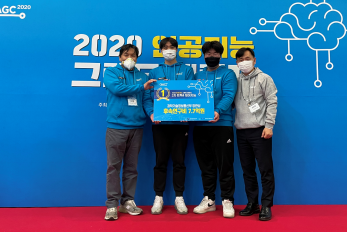
< Team USRG won the AI Grand Challenge 2020 for the second consecutive year. > Team USRG (Unmanned Systems Research Group) led by Professor Hyunchul Shim from the School of Electrical Engineering has won the AI Grand Challenge 2020 held on Nov. 23 at Kintex in Ilsan, Kyonggi-do for the second consecutive year. The team received 7.7 million KRW in research funding from the Ministry of Science and ICT, the organizer of the challenge. The team took a little over two minutes to complete the rescue operation mission of the challenge. The mission included swerving around seven obstacles, airdropping an aid package, and safely landing after identifying the landing spot. Their drone is the only one that successfully passed through a 10-meter tunnel out of five pre-qualified teams: three from universities and two from companies. The AI Grand Challenge, which began in 2017, was designed to promote AI technology and its applications for addressing high-risk technical challenges, especially for conducting complex disaster relief operations. For autonomous flying drones, swerving to avoid objects has always been an essential skill and a big challenge. For their flawless performance in the rescue operation, the team loaded an AI algorithm and upgraded their drone by improving the LiDAR-based localization system and a stronger propulsion system to carry more sensors. The drone weighs 2.4 kg and carries a small yet powerful computer with a GPU. This AI-powered drone can complete rescue missions more efficiently in complicated and disastrous environments by precisely comprehending where the drone should go without needing GPS. The team also designed an all-in-one prop guard and installed a gripper onto the bottom of the drone to hold the aid package securely. “We tried hard to improve our localization system better to resolve issues we had in the previous event,” said Professor Shim. Two PhD candidates, Han-Sob Lee and Bo-Sung Kim played a critical role in developing this drone. After their two-year winning streak, their prize money now totals 2.4 billion KRW, equivalent to the winning prize of the DARPA Challenge. As the winning team, they will collaborate with other champions at the AI track challenge to develop rescue mission technology for a more complex environment. “The importance of AI technology is continuing to grow and the government is providing large amounts of funding for research in this field. We would like to develop very competitive technology that will work in the real world,” Professor Shim added. His group is investigating a wide array of AI technologies applicable to unmanned vehicles including indoor flying drones, self-driving cars, delivery robots, and a tram that circles the campus. < Two PhD candidates, Han-Sob Lee and Bo-Sung Kim make a final touch for the competition. >
-

Feel the Force with ElaStick
ElaStick, a handheld variable stiffness display, renders the dynamic haptic response of a flexible object Haptic controllers play an important role in providing rich and immersive virtual reality experiences. Professor Andrea Bianchi’s team in the Department of Industrial Design recreated the haptic response of flexible objects made of different materials and with different shapes by changing the stiffness of a custom-controller – ElaStick. ElaStick is a portable hand-held force-feedback controller that is capable of rendering the illusion of how flexible and deformable objects feel when held in the hand. This VR haptic controller can change its stiffness in two directions independently and continuously. Since providing haptic feedback enhances the VR experience, researchers have suggested numerous approaches for rendering the physical properties of virtual objects - such as weights, the movement of mass, impacts, and damped oscillations. The research team designed a new mechanism based on a quaternion joint and four variable-stiffness tendons. The quaternion joint is a two-DoF bending joint that enables ElaStick to bend and oscillate in any direction using a pair of tendons with varying stiffness. In fact, each tendon around the joint is made of a series of elastic rubber bands and inelastic fishing lines and can vary its stiffness by changing the proportion of the two materials. Thanks to these structures, each pair of tendons can behave independently, controlling the anisotropic characteristics of the entire device. “The main challenge was to implement the mechanism to control the stiffness while maintaining independence between deformations in two perpendicular directions,” said Professor Bianchi. The research team successfully measured the relative threshold of human perception on the stiffness of a handheld object. The results showed that the just-noticeable difference (JND) of human perception of stiffness is at most about 30% of the change from the initial value. It also found that appropriate haptic responses significantly enhance the quality of the VR experience. The research team surveyed the perceived realism, immersion, and enjoyment of participants after they played with various flexible objects in VR. “It is meaningful that the haptic feedback of a flexible object was mechanically reproduced and its effectiveness in VR was proven. ElaStick has succeeded in implementing a novel mechanism to recreate the dynamic response of flexible objects that mimic real ones, suggesting a new category of haptic feedback that can be provided in VR,” explained Professor Bianchi. The team plans to extend the ElaStick’s applications, from being used merely as a game controller to driving simulations, medical training, and many other digital contexts. This research, led by MS candidate Neung Ryu, won the Best Paper Award at the ACM UIST 2020 (the ACM Symposium on User Interface Software & Technology) last month. -Profile Professor Andrea Bianchi Makinteract.kaist.ac.kr Department of Industrial Design KAIST
-
‘WalkON Suit 4’ Releases Paraplegics from Wheelcha..
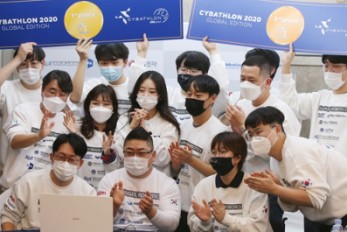
- KAIST Athletes in ‘WalkON Suit 4’ Dominated the Cybathlon 2020 Global Edition. - Paraplegic athletes Byeong-Uk Kim and Joohyun Lee from KAIST’s Team Angel Robotics won a gold and a bronze medal respectively at the Cybathlon 2020 Global Edition last week. ‘WalkON Suit 4,’ a wearable robot developed by the Professor Kyoungchul Kong’s team from the Department of Mechanical Engineering topped the standings at the event with double medal success. Kim, the former bronze medallist, clinched his gold medal by finishing all six tasks in 3 minutes and 47 seconds, whereas Lee came in third with a time of 5 minutes and 51 seconds. TWIICE, a Swiss team, lagged 53 seconds behind Kim’s winning time to be the runner-up. < Byeong-Uk Kim (left) and Joohyun Lee (right) > Cybathlon is a global championship, organized by ETH Zurich, which brings together people with physical disabilities to compete using state-of-the-art assistive technologies to perform everyday tasks. The first championship was held in 2016 in Zurich, Switzerland. Due to the COVID-19 pandemic, the second championship was postponed twice and held in a new format in a decentralized setting. A total of 51 teams from 20 countries across the world performed the events in their home bases in different time zones instead of traveling to Zurich. Under the supervision of a referee and timekeeper, all races were filmed and then reviewed by judges. KAIST’s Team Angel Robotics participated in the Powered Exoskeleton Race category, where nine pilots representing five nations including Korea, Switzerland, the US, Russia, and France competed against each other. The team installed their own arena and raced at the KAIST Main Campus in Daejeon according to the framework, tasks, and rules defined by the competition committee. The two paraplegic pilots were each equipped with exoskeletal devices, the WalkON Suit 4, and undertook six tasks related to daily activities. The WalkON Suit 4 recorded the fastest walking speed for a complete paraplegic ever reported. For a continuous walk, it achieved a maximum speed of 40 meters per minute. This is comparable to the average walking pace of a non-disabled person, which is around two to four kilometers per hour. The research team raised the functionality of the robot by adding technology that can observe the user’s level of anxiety and external factors like the state of the walking surface, so it can control itself intelligently. The assistive functions a robot should provide vary greatly with the environment, and the WalkON Suit 4 made it possible to analyze the pace of the user within 30 steps and provide a personally optimized walking pattern, enabling a high walking speed. < WalkON Suit 4 > The six tasks that Kim and Lee had to complete were:1) sitting and standing back up, 2) navigating around obstacles while avoiding collisions, 3) stepping over obstacles on the ground, 4) going up and down stairs, 5) walking across a tilted path, and 6) climbing a steep slope, opening and closing a door, and descending a steep slope. < Overview of the Powered Exoskeleton Race. > Points were given based on the accuracy of each completed task, and the final scores were calculated by adding all of the points that were gained in each attempt, which lasted 10 minutes. Each pilot was given three opportunities and used his/her highest score. Should pilots have the same final score, the pilot who completed the race in the shortest amount of time would win. Kim said in his victory speech that he was so thrilled to see all his and fellow researchers’ years of hard work paying off. “This will be a good opportunity to show how outstanding Korean wearable robot technologies are,” he added. Lee, who participated in the competition for the first time, said, “By showing that I can overcome my physical disabilities with robot technology, I’d like to send out a message of hope to everyone who is tired because of COVID-19”. Professor Kong’s team collaborated in technology development and pilot training with their colleagues from Angel Robotics Co., Ltd., Severance Rehabilitation Hospital, Yeungnam University, Stalks, and the Institute of Rehabilitation Technology. Footage from the competition is available at the Cybathlon’s official website. (END)

291 Daehak-ro, Yuseong-gu, Daejeon 34141, Republic of Korea
KAIST, N7 Building, Room 2501
T.+82-42-350-2114
F.+82-42-350-8500
ⓒ KAIST College of Engineering. All rights reserved.